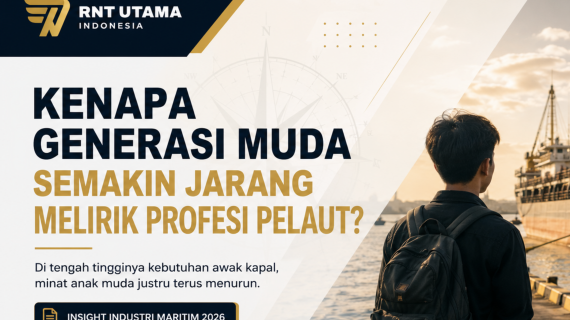
Amid rising unemployment rates and increasingly competitive job markets, there is an interesting fact that is rarely discussed: the maritime and fishing industries are actually experiencing a shortage of young workers. Shipping companies, fishing vessels, and international cargo fleets continue to recruit crew members, yet interest among younger generations in pursuing a seafaring career has steadily declined over the years.
This trend is particularly concerning because the seafaring profession has long been known as a career that offers competitive salaries, international work opportunities, and a clear path for career advancement. So why are fewer young people considering a career at sea today?
1. Changing Mindsets Among Younger Generations
Today’s generation has grown up in the digital era. Many young people aspire to become content creators, digital marketers, programmers, designers, or professionals in other technology-driven industries.
Social media has also shaped perceptions of what an ideal job looks like. Many young people now seek careers that offer flexibility, remote working opportunities, and the ability to earn income without leaving home. In contrast, the seafaring profession is often viewed as a career that requires spending months away from family and friends.
As a result, many young people never even consider becoming a seafarer as a viable career option.
In reality, however, the maritime industry remains one of the world’s most important sectors and continues to offer substantial employment opportunities both domestically and internationally.
2. Limited Awareness of Maritime Career Opportunities
One of the primary reasons behind the declining interest is the lack of information available about maritime careers.
Many high school graduates, vocational school students, and even university graduates are unaware that the maritime industry offers a wide range of career paths. They often assume that all crew members perform the same duties, when in fact there are various positions with different responsibilities, qualifications, and salary levels.
On fishing vessels, for example, positions may include:
- Deck Crew
- Bosun
- Chief Officer
- Captain
- Engineer
- Chief Engineer
Merchant vessels offer even more specialized career opportunities depending on an individual’s skills, certifications, and experience.
Without proper education and exposure, many young people fail to recognize that seafaring is not simply physical labor but a professional career with structured progression and long-term growth opportunities.
3. The Perception That Seafaring Is Extremely Difficult
There is no denying that working at sea comes with unique challenges. Seafarers must adapt to changing weather conditions, ocean waves, strict work schedules, and a working environment that differs significantly from land-based jobs.
However, these challenges are often exaggerated, creating the perception that seafaring is an exceptionally difficult and dangerous profession.
The reality is that the modern maritime industry has evolved considerably. Advanced navigation systems, safety technologies, communication equipment, and international operational standards have made working onboard vessels significantly safer than it was decades ago.
Professional shipping companies also provide safety training, clear operational procedures, and protection measures that comply with international regulations.
4. Concerns About Being Away From Family
One of the most common reasons young people hesitate to pursue a maritime career is the prospect of being separated from their families for extended periods.
Employment contracts may last several months or even a year, depending on the vessel type and employer. For many young individuals, this arrangement seems unattractive because they are accustomed to constant communication and daily interactions with loved ones.
However, modern communication technology has made it much easier for seafarers to stay connected with their families. Many vessels now provide communication facilities that allow crew members to make calls or send messages whenever conditions permit.
Furthermore, the financial rewards often compensate for the temporary sacrifices required during contract periods.
5. Limited Promotion of Maritime Careers in Education
When students are asked about their dream careers, most mention professions such as doctors, teachers, police officers, military personnel, or office workers.
Very few educational institutions actively introduce seafaring as a promising career option. Consequently, many young people grow up without understanding the opportunities available within the maritime sector.
This is particularly surprising considering that Indonesia is the world’s largest archipelagic nation, with vast maritime resources and strategic shipping routes.
Given the country’s geography, the maritime industry should naturally be one of the largest sources of employment for Indonesian workers.
Unfortunately, insufficient awareness campaigns and educational outreach programs have caused maritime careers to receive far less attention than other professions.
6. The Rise of New Career Options
Compared to two decades ago, today’s young generation has access to a much broader range of career opportunities.
Many choose careers such as:
- Content Creator
- Influencer
- Programmer
- Data Analyst
- Social Media Specialist
- Freelancer
- Digital Marketing Specialist
- E-commerce Entrepreneur
These professions often appear more modern, accessible, and aligned with current lifestyle trends.
Meanwhile, the maritime sector is still frequently perceived as a traditional industry, despite undergoing significant technological transformation. Modern vessels increasingly rely on digital navigation systems, automation technologies, data-driven fleet management, and sophisticated communication tools.
The maritime industry is far more technologically advanced than many people realize.
7. Misconceptions About Seafarers’ Income
Many people assume that seafarers earn average salaries. In reality, experienced crew members often earn significantly more than many land-based workers with similar educational backgrounds.
For those employed on international vessels, the opportunity to receive salaries in foreign currencies can be especially attractive.
In addition to basic wages, seafarers often benefit from accommodations, meals, transportation, and other allowances provided by employers, resulting in lower personal living expenses during contract periods.
Unfortunately, because this information is not widely known, many young people remain unaware of the strong financial potential offered by maritime careers.
8. The Maritime Industry Needs More Young Talent Than Ever
Ironically, while interest among younger generations continues to decline, demand for maritime professionals keeps growing.
Global trade still depends heavily on maritime transportation. Likewise, the fishing industry continues to expand in order to meet increasing global food demands.
This means that the need for qualified and professional seafarers is unlikely to disappear anytime soon.
In fact, many shipping companies actively seek young individuals who possess discipline, adaptability, and a strong willingness to learn and develop long-term careers within the maritime sector.
It Is Time to Change the Perception of the Seafaring Profession
Being a seafarer is about much more than working at sea. It is a profession that plays a critical role in the global supply chain, connecting countries and supporting international commerce.
With competitive salaries, opportunities to work internationally, structured career advancement, and strong industry demand, seafaring remains one of the most promising career paths for young Indonesians.
To increase interest among younger generations, greater collaboration is needed between educational institutions, government agencies, shipping companies, and maritime recruitment organizations to provide accurate information about the industry.
As a trusted maritime recruitment and crew management company, PT RNT Utama Indonesia believes that Indonesia’s young generation possesses tremendous potential to build successful careers in the global maritime industry. Through proper training, professional development, and legal placement opportunities, Indonesian seafarers can compete internationally and create brighter futures for themselves and their families.
While digital careers continue to attract significant attention, the maritime industry remains a sector filled with opportunity. The challenge is not the lack of jobs, but ensuring that young people understand the vast career potential that still awaits them beyond the horizon.